
Seeing is believing: How Cushing’s disease affects my vision
Side-by-side images show how my eyesight is impacted by high cortisol levels
Written by |





I have very odd eyesight problems that are caused by Cushing’s disease, including visual snow, floaters, halos, and night blindness. According to neuro-ophthalmologists that I’ve seen, my actual eyesight is fine. My issues are caused by the high levels of cortisol in my body.
My body responds to stress with increased pressure and visual disturbances. I first started having these issues before I was diagnosed with Cushing’s disease and had my first tumor-removal surgery, but nothing has made them disappear. Treatment, surgery, rest, and many, many specialists have proven that this is just a part of my life now.

A look at how I see
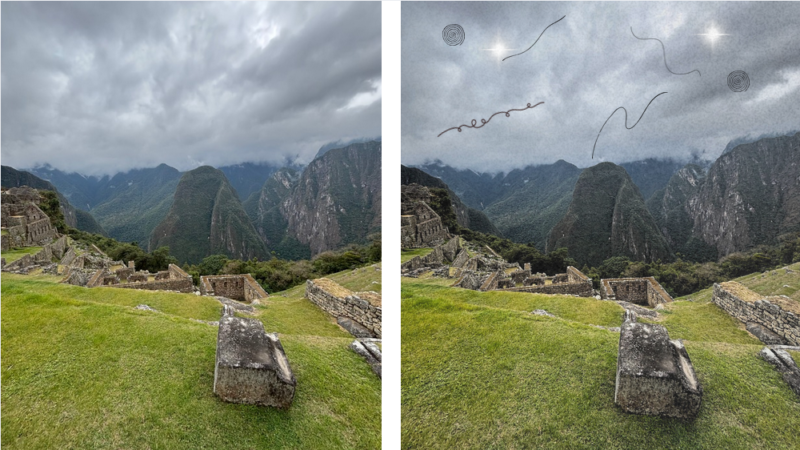
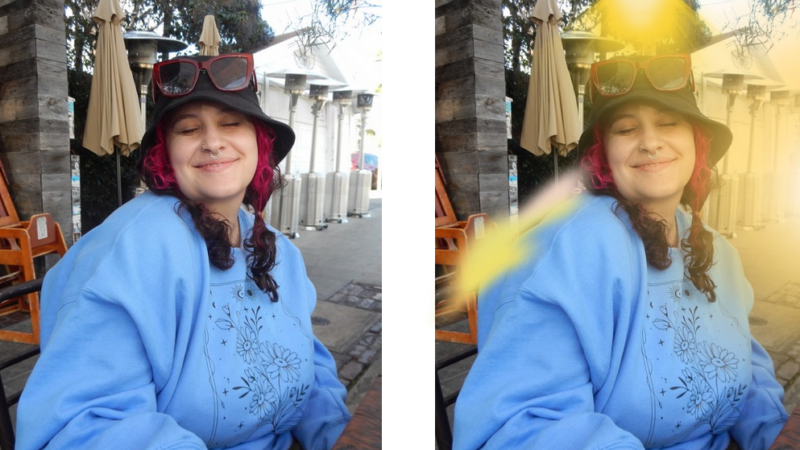
I’ve described these disturbances before, but people in my life have said they don’t really understand what I see. Therefore, I decided to make a visual guide of how my eyesight differs from others, with the help of a digital imaging program.
(Photos by Noura Costany)
Here are two pictures of a recent trip to Machu Picchu in Peru. On the left is the picture I took with my camera, and how the average eye sees this great wonder. On the right is my view. Since this day was both cloudy and sunny, my eyesight was particularly bad, with a general static over everything I saw, plus swirling floaters. I also had flares of light. Usually, on cloudy or rainy days when there is a lot of gray in the sky, I’ll get a headache from all of these disturbances and need time to recuperate.
(Photos by Noura Costany)
This is an example of the halos, either white or yellow, that I see around people pretty much all the time. The brighter it is outside, the worse the halo tends to get. Sometimes it can be so bad, I can’t fully make out a face, but usually it’s more subdued and kind of a fun accent around their body.
(Photos by Noura Costany)
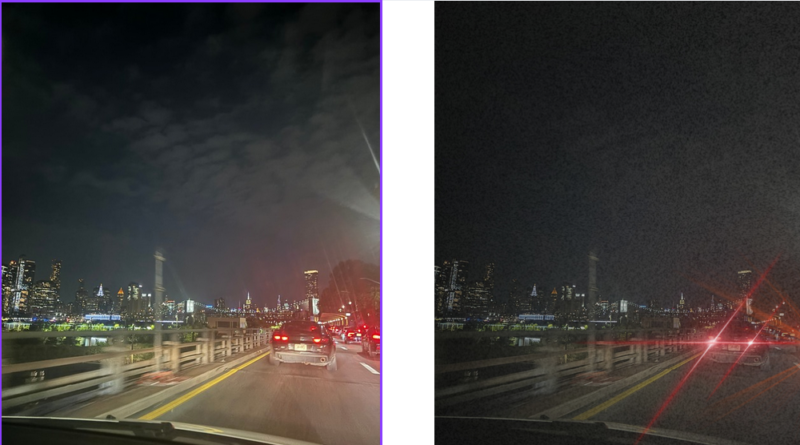
The night is the worst for me. I have night blindness, so I’m unable to see anything that isn’t very well lit. My husband and I realized this when I tried to prank him in a dark room by sneaking up to him, and he laughed and said, “You know I can see you, right?” I hadn’t realized that my view had been so dark.
As you can see, there is a dimmed view around me. What’s bright is still visible, but less so. The static is much worse at night. I also struggle with lights in the dark because they have added flares.
Aside from this, I cannot read a book in a dim room, because the words aren’t visible. I also need help moving around outside at night and need to carry a flashlight in my bag. I can’t drive at night, either, since I can’t see more than a few feet ahead.
These disturbances in my vision aren’t just bizarre, they really affect me. I need to take breaks throughout the day because I see floaters on my computer screen. I get migraines from straining to see past the floaters and the static my own body is creating. It can be bothersome and frustrating, but over time, I’ve come to accept that this is how I see the world. A little bit more colorful, and a little more weird, thanks to Cushing’s disease.
You can also follow my journey on TikTok and YouTube.
Note: Cushing’s Disease News is strictly a news and information website about the disease. It does not provide medical advice, diagnosis, or treatment. This content is not intended to be a substitute for professional medical advice, diagnosis, or treatment. Always seek the advice of your physician or other qualified health provider with any questions you may have regarding a medical condition. Never disregard professional medical advice or delay in seeking it because of something you have read on this website. The opinions expressed in this column are not those of Cushing’s Disease News or its parent company, Bionews, and are intended to spark discussion about issues pertaining to Cushing’s.


Lucie Irvine
Hi there, pretty normal view of valley the lites are diff. I'm the noises in head since op. Eyes are different left,right have to close one duhh